What is Reproductive Justice?
This is about supporting Choice + Access: the ability to make continuous, autonomous choices in everyday life and throughout life regarding one’s reproductive health. This includes the choice to have or not have children, and to parent children in a safe environment. These choices are only possible through universal access to affordable and appropriately-designed products and services. If companies in this area succeed, more Women+ 1 will access to the care they desire and can meaningfully engage in other aspects of their life and with the economy overall.
The overturning of Roe v. Wade has created significant constraints to securing Reproductive Justice for all. The ruling has restricted access to reproductive health services based on location, increasing the urgency and need for start-ups to fill the void created while also complicating their addressable market.
Positive regulatory changes include:
- The Build Back Better Act and framework from 2021, which includes ~$1B on maternal health funding to diversify the workforce, improve data collection and monitoring, research, and support the building of maternal health homes by states.
- Vice President Harris’s Call to Action on Maternal Health in April of 2022, which has resulted in:
- 4 States expanding Medicaid coverage from 60 days post birth to 12 months (approval is pending in another 11 states).
- $16M for the expansion of Maternal, Infant, Early Childhood Home Visiting Programs
- $4.5M to train, hire, certify and compensate community based Doulas in areas of high rates of adverse maternal and infant health outcomes
- Additional private sector pledges to support maternal health care
- And The PUMP Act, signed in Dec 2022, now requires employers of all sizes to provide a reasonable break time and a private space for lactating workers to express milk for up to one year following the birth of their child.
1We’re borrowing the term Women+ from Rock Health to include “cisgender Women, as well as others whose health needs relate to those of cisgender Women but may identify as transgender or nonbinary.”
How big is this thematic area?
The framework Reproductive Justice was coined by social activists to define their body of work, not investors, so market sizing isn’t readily available or straightforward to calculate. But here are a few perspectives on the size of the market:
- Measured by the number of affected individuals: As of December 2020, there are 64.5M Women+ between 15-44 years of age in the United States continually make reproductive decisions. In considering equitable access to care, it’s important to note that, according to the linked report, 12.9% were living in families with incomes below the Federal Poverty Level.
- Measured by cost on society: $32.3B is the medical and nonmedical cost on society of the health conditions stemming from or worsened by pregnancy (five years postpartum) according to the Commonwealth Fund. Their report breaks down those costs by category:
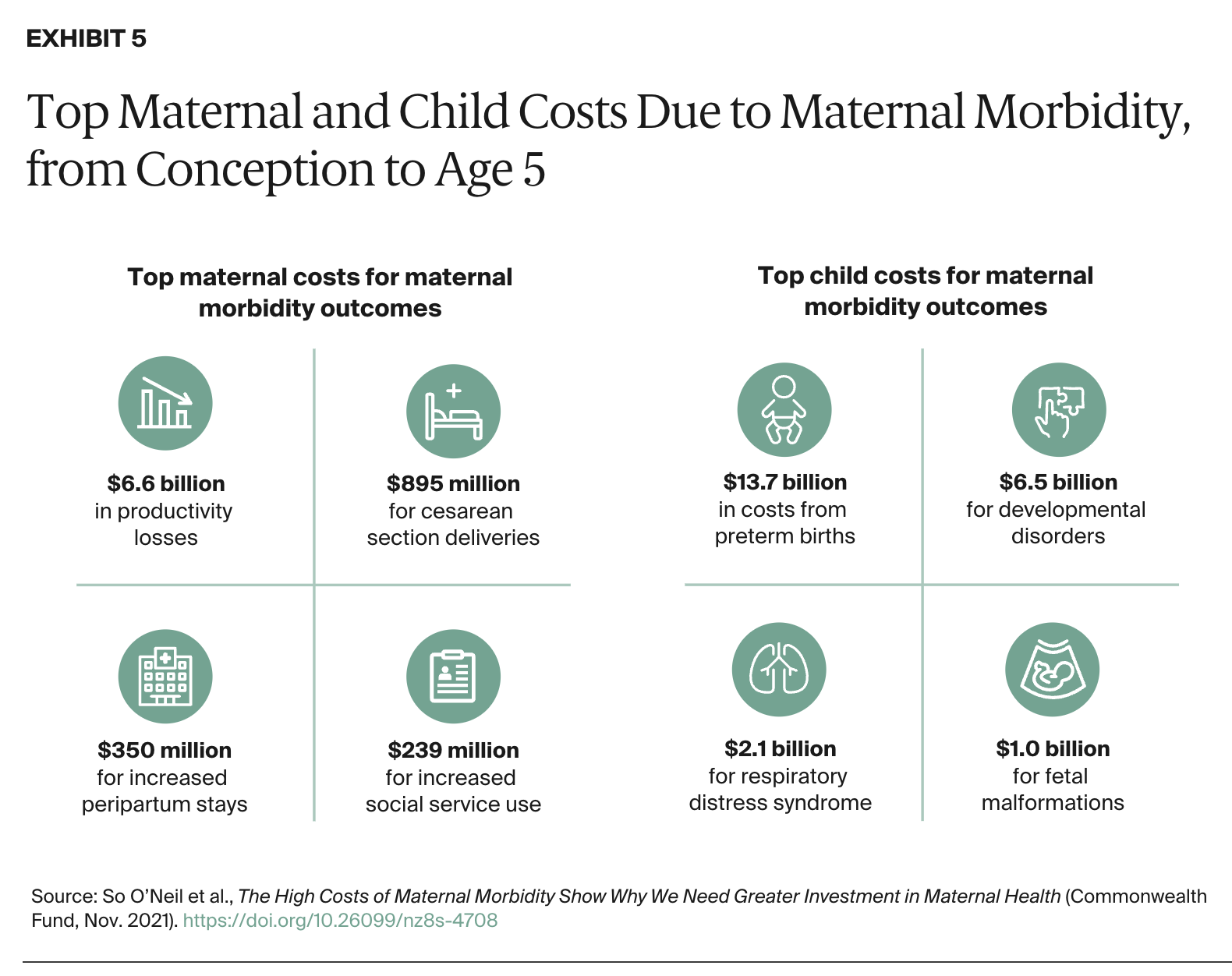
The Commonwealth Fund — The High Costs of Maternal Morbidity Show Why We Need Greater Investment in Maternal Health - Measured by a closely related sector: FemTech itself is estimated to be between $500M and $1B according to McKinsey. Entrepreneurs, investors, and analysts have produced their own related categorizations: Women’s Health, Reproductive Health, Famtech, and more. From that analysis, companies offering services and support for Maternal Health, Menstrual Health, Fertility, and Contraception would be the most relevant for our fund’s investment thesis. Those are highlighted in red. Within those categories, our fund’s investment thesis prioritizes companies that work with or accept state Medicaid programs because they serve populations with limited income.
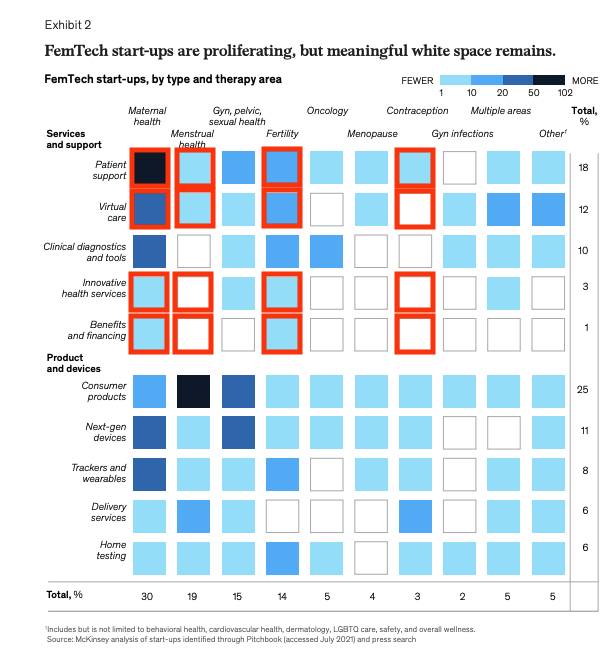
McKinsey & Company — The dawn of the FemTech revolution - Filtered by Medicaid spending: it’s reported that between 40-50% of births in the U.S are financed by Medicaid (65% of births for Black mothers) and while it’s difficult to find recent data on Medicaid spending expenditures related to family planning, ~$1.5B was spent in FY 2015 and it’s safe to assume that number has grown given rising costs of healthcare. In addition, expenditures for the Children’s Health Insurance Program (CHIP) were $20B in 2020. CHIP is a jointly funded state and federal program that helps families who are not eligible for Medicaid due to income but still have difficulty purchasing health insurance.
A few active startups that demonstrate this thesis
- Kiira: Helps Women+ easily access quality telemedicine or in-person healthcare for primary, OBGYN or mental healthcare. It features
- Connected care - So much of healthcare is disjointed today, the idea of bringing together these services is an attractive value proposition for users.
- Culturally competent providers - the website lists 6 providers who are all Black Women+. The use of Black healthcare providers is an attractive feature for Black Women+ who have a general mistrust of healthcare providers and therefore want providers that look like ourselves. The mistrust is earned given the dark history of Modern American Gynecology and reinforced with traumatic stories of childbirth from present day role models Serena Williams, Beyonce, and 3/4ths of Team USA’s 2016 Olympic 4x100 team: Allyson Felix, Tianna Madison and Tori Bowie. Sadly, Tori Bowie recently passed away from pregnancy complications in April of 2023.
- Mae: A digital health solution that connects Black expectant mothers with Doula led support, weekly check ins, education and connections to medical interventions. It features:
- Doulas: Having a Doula present to support and advocate on the behalf of the mother and baby leads to better health outcomes, yet it’s a service that can cost between $500 - $1000 dollars for parents. By working with Medicaid - the parents are able to use this healthcare benefit with no costs out of pocket. Plus, this allows Doulas to work with the populations they want to serve without sacrificing their income potential.
- A focus on Black expectant mothers.
- A Virtual care model that provides Medicaid access to rural populations on a more frequent basis than otherwise due to transportation time and costs.
- Seven Starling: Platform creating care plans for Women+ focused on mental health concerns related to parenthood. Plans include a combination of therapy, peer support and medication for concerns including navigating fertility issues, miscarriages, pre and postpartum support, abortions, and parenthood. Other notable features include:
- Community: Women+ often report feeling alone during the postpartum period, having a space where other Women+ can validate their experiences makes for a strong community.
- Navigating costs: according to the website the team helps finding the most affordable way to start therapy which is beneficial in an opaque industry
- She Matters: Digital health platform designed to provide Black mothers who experience postpartum anxiety/depression with community, culturally relevant resources and culturally competent therapists. Features include:
- Free therapy - this is a large driver of users to the platform and could be the wedge towards getting users to continue engagement on the platform and expanding use of paid services.
- Looking to expand into providing certifications for culturally competent medical providers so Women+ within the community know where they can go and feel seen and safe. This has the potential to be a strong value proposition for the B2B portion of the revenue model.
- Community: similarly to Seven Starling, having a space where other Women+ can validate their experiences makes for a strong community and increased engagement.
- Twentyeight Health: Telehealth company increasing access to healthcare for underprivileged communities. Notable features include:
- A focus on solving the access issue for low income populations, given that 55% of users on Medicaid and 63% of birth control users don’t have access to birth control prescriptions before using their services. The uninsured pay a $20 annual fee for telehealth appointment and prescriptions start at $16 a month for birth control pills.
- Both B2B and B2C revenue models, with the majority of revenue coming from multiyear state contracts.
Demonstrative Exits
As a VC firm prioritizing impact and financial returns, we evaluate potential investments in any thematic area against likely outcomes. I analyzed over ~300 companies through Pitchbook (accessible via this list)2, and the most noteworthy transactions were providing affordable, convenient care through telehealth. A few examples:
- Lemonaid Health, a provider of telehealth services focused on bringing more convenient and affordable healthcare to all Americans, was acquired by 23andMe in November of 2021 for $400M. The company claims to be the first app in the US to provide access to the contraceptive pill.
- Nurx - a telehealth services platform focused on sexual health that merged with Thirty Madison (an online specialty health care company) in February of 2022. No financial details on the transaction were shared but prior to this transaction, Thirty Madison raised $140M at a valuation of $1B in 2021 and Nurx was valued at $332M according to Fast Company. Together they provides support for a variety of concerns from accessing birth control or emergency contraceptives to treating allergies.
- Maven Clinic, a digital health platform for Women+ and families, raised $90M in November of 2022 bringing their valuation to $1.35 billion. The company works with employers to offer support across fertility, pregnancy, adoption, parenting and pediatrics. The company saw an 67% increase in companies looking to add reproductive health benefits the month after the Supreme Court’s Dobbs ruling. While this isn’t an exit, their valuation demonstrates the value of the business model.
2If you would like access to the company list and do not have Pitchbook, feel free to reach out and I will share the list.
The landscape of investors and supporting organizations
We can’t make investments and support companies in a vacuum. We need solid syndicates of investors supporting companies to exit. And we need an network of organizers and experts to help define positive outcomes and pathways to them.
Notable Investors
- Acumen America is an early stage venture fund focused on harnessing the power of entrepreneurship to alleviate poverty. They are invested in Mahmee, a mobile platform that makes it easy for hospitals, health systems, and their patients to coordinate comprehensive prenatal and postpartum healthcare from anywhere.
- Emmeline Ventures makes pre-seed and seed stage investments in “game-changing businesses which empower women, in particular, to manage their health, build their wealth, and live in a cleaner, safer world.” They are invested in She Matters (mentioned above), LunaJoy, a digital mental health clinic for women and Ruth Health, a telehealth platform for postpartum women.
- Genius Guild invests in the future of health. Early this year the firm published their perspective in an article entitled Investing to Reduce Racial Disparities in Maternal-Child Health. They are invested in Health in Her Hue, which connects Black women and women of color with culturally sensitive healthcare providers and Juno Medical which provides comprehensive care with an emphasis on the “Chief Caregiver”, typically mothers.
- RH Capital invests in women’s health with health equity at the core. In August of this year fund team members appeared on an episode of the Legally Femtech podcast where they discussed the Femtech Investment landscape. Given the close alignment of their investment thesis with this analysis, see their entire portfolio rather than a few selections.
- Serena Ventures was founded by tennis great Serena Williams. She penned an article about her own traumatic experience as a Black expectant mother in Elle. The fund is invested in Juno Medical, alongside Genius Guild.
- Steelsky Ventures invests in the future of Women’s healthcare. The fund is invested in both Twentyeight Health and Mae, both mentioned above, along with Bend Health, a virtual mental health clinic for women and families and Cayaba Care, which provides home-based pregnancy support to underserved communities.
Organizations
- HealthTech4Medicaid — dedicated to supporting innovation in Medicaid. The organization was founded by 40 HealthTech CEOs collectively representing more than $1B in VC backing.
- SisterSong — the largest multi-ethic organization focused on reproductive justice. Their framing of the issue influenced the reproductive justice framework used to characterize this landscape analysis.
- Pro Repro — supports and advocates for the advancement of economic empowerment of people who can become pregnant, including Women+’s economic empowerment, worker rights and workplace equity.
- California Maternal Quality Care Collaborative — committed to ending preventable morbidity, mortality and racial disparities in California maternity care. The organization helped decreased maternal mortality and morbidity rates by 65% in California during a time period where the national rate rose.
- Title V Maternal and Child Health (MCH) Block Grant Program — administers grants to states since 1935 to help assure access to quality maternal and child health cares services to mothers and children. This is better classified as a government program but I wanted to include it here given the longevity of the program.